Friday, May 15, 2009

The Way of Nature

Today i was surprised by a flock of birds chirping noisily as i had my morning tea alone.   I looked out into the garden and saw about 10 little birds flying back and forth from one tree in my garden to various spots around it.   They seemed to be eating something, so i watched closely.  

The birds came back and forth the "yuzu" tree, not a very tall tree, as i cut the top regularly so it only grows up to my shoulder.  It has been a good tree, bearing about 6 to 10 yuzu fruit every winter. 
   
I remember more than two weeks ago i noticed a few butterflies flying around it and earlier this week i was worried when i saw some young leaves eaten.  I contemplated about picking those caterpillars, not quite sure if i have the gut (nor the heart) to kill them as much as i am scared even to touch them.    I could have asked my daughter who is never scared of any insects, but i know she would say no to killing her favorite insects.

Now i was somewhat relieved to see the birds feeding on the caterpillars and some of the larvae. After all the nature works so wonderfully around us that we sometimes should take our hands off and just watch the wonder of God's creation.   

As i am typing this, i can hear the chirping noise quiet down.   They had finished lunch, i guess.   Now it is time for mine....


Monday, May 11, 2009

Children's Day May 5th - For Boys? or Both?

In Japan Children's Day celebrated on May 5th is a celebration not only for children but also for a meaningful day for mothers.   Since 1948 the Japanese Government dedicated May 5th as a national holiday - a day to celebrate children - to appreciate the well being of children and a greetings for the children with appreciation to their mothers.   However, the Japanese people in general follow international calendar (May 10th) when celebrating Mother's Day.

The celeberation of Children's Day has been around in Japan since early 1900, during the Taisei Period (1912).  In the past Children's Day was mainly a celebration for the boys - originally it was a celebration to wish health for boys. Meanwhile, girls has their during the Hinamatsuri Festival.   However since the Hinamatsuri Day on March 3rd was not announced as a national holiday, while May 5th was dedicated as a national holiday, at some point in time people started to argue that there was a discrimination between boys and girls.    In the last few decades, the culture of celebrating only boys on May 5th has gradually changed.   Practically boys and girls enjoy May 5th the same way at home and anywhere else, such as they can both get into the national zoo, national museum and other public facilities for free on that day.

The most common way of celebrating children's day are to place a decoration called "Koi-nobori".   In the past families with boys put up "Koi-nobori" or carp streamers, in their garden and a display of dolls called gogatsu ningyo (the same way families of girls display Hina dolls during Hinamatsuri Festival) in a room of the house.   Nowadays, families with children put up "koi-nobori" regardless of their children's gender.  The meaning of "koi-nobori" display " the carp appear to be swimming vigorously against the current" is to symbolize how boys should face and overcome their difficulties with the same positive spirit.   

Gogatsu ningyo or dolls for boys celebration usually contains a set of samurai armour, a kabuto (samurai's helmet), a taiko (big drum) and other things needed to fight an old style battle.  This decoration also symbolizes that boys should be strong to face any difficulties with the necessary equipments.   Families with girls do not display gogatsu ningyo, instead they put up "koi-nobori" which has similar meanings.

For the first time ever, on May 4th 2009 (US Time) US Secretary of State made a statement on Japanese Children's Day, May 5th.

It is my pleasure to offer warm wishes to boys and girls in Japan on the May 5 occasion of Children’s Day. On this holiday, Japanese families celebrate the joys of childhood and family life. Children are, indeed, a national treasure, and both the United States and Japan share a strong commitment to childhood health, safety, and education. It is a responsibility for all of us to work together to ensure the protection of children. It is our hope that one day children from all countries will be able to celebrate the carefree joys that children in Japan celebrate today.

Friday, May 1, 2009

The Golden Week

Every year in early May, Japanese have about a week of public holiday called the Golden week.   The publich holiday itself occurs on April 29th which is the Showa Day, then May 3 which is the Foundation Day, May 4th which is the Green (Environment) Day and May 5th which is the Children Day.   Like this year, when May 3rd public holiday falls on a Sunday, the government added May 6th as a replacement holiday.   In most cases these consecutive public holidays together with a weekend creates just about a week holiday, that way the Japanese get to take longer holiday.  

Most factories and offices closes for a week, usually starting from April 29th to May 4th.   Foreign visitors who visit Japan should avoid this week, unless prior arrangements for hotels and travels have been made earlier on.    The Golden Week period is usually the busiest time of the year for local Japanese.   Some will travel back home to their home town, many of which are located in outskirt villages and for those living in the villages to travel to the city.   Others will travel overseas. Places to avoid during Golden week when you visit Japan are the Express Highway (See Both Photos - normal days vs. golden week), major stations like Tokyo, Shinjuku, Ikebuburo, Ueno, the domestic airport and to some extent international airport.

Other than that, as the name says, it is indeed a "golden" week opportunity for those working people - who rarely have a chance to take holidays, as they can take a holiday with the whole family.   Children's schools are close during the same period allowing them to go with their parents for a holiday.


Saturday, April 25, 2009

Fire Festival (Hitaka Hibuse Festival)

In Japan most houses are made of woods and it has been since the Edo era (1603 - 1867).   Nowadays more and more people live in apartment buildings, however the presence of woods and timber, used for housing and Japanese papers, remains critical to Japanese lifestyle.   Forests in Japan covers about 66% of the whole land, which is the largest ratio among developed countries.

In the history during the 267 years of Edo era there was 96 fire accident that has destroyed 1636 meters length of area and among them three were recorded as the biggest fire ever occured in Japanese history.   The Japanese Emperor at the time recognized the need to improve the mechanism of reducing the number of fire and conducted some study including the introduction of what the Japanese now call Hitaka Hibuse Festival - a celebration to remind people of how fire occurs easily during every change of seasons and that people should be more careful when handling fire.   

The Japanese continue to celebrate this Festival even after over 300 years.   Nowadays the festival is held throughout the nation, with the big ones held in Iwate and Kyoto.   This festival now becomes a major tourist attraction among locals and foreigners. For those travelling in Japan,  you can visit Iwate-ken to witness this festival from April 28-29.

http://www.bunka.pref.iwate.jp/

Saturday, April 18, 2009

Magic in Tea Ceremony

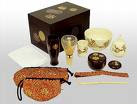
Today i went to a typical tea ceremony on a local Spring Festival.   You probably already know that tea ceremony which is very popular in Japan, was actually introduced from China.   The way of conducting tea ceremony was later on perfected by Master Sen-no-Rikkyu based on the spirit of Zen during the 16th century.
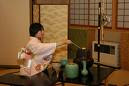
Do you know why you have to turn the cup twice (clockwise) before you drink the tea?
* Apparently when the tea master serves your tea, the cup facing you is supposedly to be the best side of the cup, i.e. note that cups used in tea ceremony usually has elaborated design.   This is a way of showing respect towards the guest.   However, the reason why you turn in twice (clockwise) is for you to return the respect towards the tea master, i.e. by showing the best side of the cup towards the tea master.

Do you know why you have to turn the cup once (anti-clocwise) after you finish drinking your tea, just before you place the empty cup on the tatami?
* By turning it once anti-clockwise the best side of the cup should face the person next to you, thus showing respect towards the other guests.

What do you say to the other guests, facing the person next to you, before drinking your tea?
* O-saki ni (excuse me, may i drink this tea before you?) - this is to show politeness towards the other guests who have not had their turns.

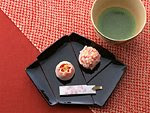
Do you know why "quietness", "stillness" and "observation" are the key to enjoy tea ceremony?  * Tea ceremony as the words say, is not just a way of enjoying tea, but a ceremony of a mental discipline for the purpose of achieving peaceful mind - the profound teaching of Zen. In quietness and stillness you can observe the way of tea making, the sound of water, the movement and enjoy how each season is portrayed differently in ways of presentation, such as in the use of cups, color of kimono, tools used in the ceremony and seasonal Japanese sweets.

Nowadays, tea ceremony is not only known in Japan but internationally such as in the US and Europe.    Some people may consider tea ceremony a rather uptight activity as it involves a lot of procedures and rules.   The truth is it is understandable for beginners not to know some of the rules and the tea master, in most cases, will explain to beginners in details on "what to do" during tea ceremony.     

Finally to lighten up, check out below a Japanese TV program showing a magic performance conducted during a tea ceremony, ... something rare.  Enjoy!

Saturday, April 11, 2009

Easter Eggs

Happy Easter to those celebrating!  from us, somehow pictured as the easter egg family :-)

Why Easter Eggs?  Easter eggs & baby chicks- Eggs and chicks symbolize new life. Eggs have been a symbol of spring since ancient times. An egg also is a symbol of the rock tomb out of which Christ emerged when he arose again. The chick, hatching out of the egg, symbolizes new life or re-birth.

Monday, April 6, 2009

The Beauty of Down Under

QUIZ

1. In which country is this island located?
2. Think of size and ratio, how many Japan can fit in this country?

Hint:
... a beautiful place surrounded by sea ...
... some place hot some place tropical ...


Posted by Picasa

Friday, April 3, 2009

Only In Japan?

Would you like to have a taste of a banana that costs 600 Yen "each"?  This banana, branded Penguin Banana, is available only in Japan (currently) and selling reasonably well in Osaka at 600 Yen each.    Someone who has eaten it said that it is not only sweet and rich in taste, however the after taste is not heavy or filling, in fact rather refreshingly fruity.

The taste is special because this banana matured very slowly, which requires twice longer the time needed for an ordinary banana.   It is also specifically grown and nurtured in such a way that you can only collect one or two of such a banana for every single tree.

The fact that this banana is selling quite well at such a price shows 
a new trend of fruit consumption in Japan.    Research also showed that overall banana market in Japan is the least effected by changes in the economy at present.   

I personally find it hard to believe that one 
would spend 600 Yen on a banana instead of a dessert set, say a standard strawberry cream cake with a cup of coffee, which you can get for the same price here ...

Tuesday, March 31, 2009

About Urushi ("Japan" in English)

Some people here believe that the origin of urushi began in China, where they found what an urushi made 7000 years ago.   However, an archaeologist in Japan found a piece of urushi in Hokkaido, dated back to 9000 years ago.   This one and only piece of proof that urushi started in Japan was lost in a fire.   Until today the archaeologists are still investigating the history of urushi and accepting the possibility that urushi might have came from China over 10000 years ago, along with the very rare, unique and skilled techniques of its making.

I think urushi is a very special piece of artwork and i have seen some extraordinary pieces of urushi in Fukushima, Aizu
.  Whether the origin was indeed China, i believe that Japan has for the past thousands years master the production of "urushi", now known as "Japanese lacquer" in English.

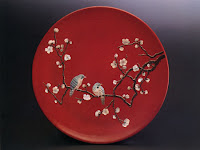
Urushi is made from a special tree, called urushi tree or black tree, where you derive a nature made lacquer to make black, dark red or red color depending on the process and species of trees. Japan has a long history and culture in the making of urushi just the same way China does in the making of ceramics (well known as bone China).    In English "urushi" is called Japan ware or just Japan.

The making of urushi involves an elaborate work of maintaining a certain temperature at every single steps.  Urushi, which is strong against heat, humidity, acid or alkaline, is used to make traditional kitchen ware (cha-zutu or ocha-container, bowl, bento/lunch box, etc.), Japanese instruments (such as koto) and furniture.   However, urushi  is weak when it comes to direct sunlight or UV.  It is also weak against sudden change in temperature and humidity.    The piece may break or develop a crack over a period of such exposures.   Golden color used in urushi is made with a real gold powder and involves an elaborate work of putting it layers over layers, more than 100 times.

When you buy urushi for kitchen ware, you may wonder how to use and wash them.   Here are the common rules for keeping your precious urushi (from the Aizu Urushi Foundation):
1. No direct contact with fire (which is obvious since it is made of solid wood)
2. Do not put them in microwave, oven, fridge, dishwasher.
3. When you use hot water  (whether during washing or making tea - as for teapot), you need to understand that the color of urushi will change over a period of time.    In order to maintain its beauty, you are supposed to dip the urushi into a slightly warm water before using hot water, or in other words, to avoid the sudden change of temperature, you need to prepare a few steps of work.
4. If you have urushi cups - that you use to serve tea, the same process is needed to maintain its color and to avoid cracks.    Also make sure that you do not leave any liquid for a long time in such urushi since it will affect .   After washing, it is better to wipe it dry with a towel instead of leaving it dry naturally.
5. For a long time storage urushi is best kept at a certain humidity, therefore it is recommended that you store it in a cupboard with a cup of water to maintain humidity.

Now you may ask me why Japanese like to use such a kitchenware that requires elaborate work just to maintain it.   I think it is indeed a Japan ware, rooted with a deep Japanese culture, since it requires elaborate work making it, it is only fair that you need to put elaborate work maintaining such a piece of art.

Sunday, March 15, 2009

Hanami - Cherry Blossom Outdoor Party

Sakura or the cherry blossom is the national flower of Japan and is considered by most Japanese their favorite flowers.   Spring is the time for Hanami where Japanese gather and held parties in the open air under the cherry blossoms.   It is more like having picnic out in the park, except that during cherry blossoms season, most parks are filled with people doing various activities other than just having picnics.
A recent TV program showed that activities held during hanami have changed over the decades. Prior to 1970s Japanese people enjoyed outdoor dancing and singing at hanami parties.  In the 1970s singing like in karaoke replaced dancing.  In 1980s playing famous animation characters is the common show during hanami.  In the 1990s people started to commercialize such a show, so you can find individual stands where they perform for public, whereas in the past you would see such performances done by a member in the group during the party itself.   In recent years most people enjoy a more simple hanami by having outdoor picnics, drinking and talking.   There are fewer performances outdoor.   

In the past many hanami parties were held among workers in the company, whereas nowadays they are more held among closed friends.   The custom of going to the park to reserve the best location for hanami parties was common in the past, which was in most cases done by the newly graduate workers.

In Tokyo area Yoyogi Park, Shinjuku Gyoen and Ueno Park have the best collection of cherry blossoms.   Some people, like me, enjoy hanami at a nearby park just a few minutes walk from home.   After all the key to a wonderful hanami is "the food"-> a delicious bento (lunch box),  a warm sake for appetizer and sakura mochi for dessert.   For recipes of bento (left) check out http://cook4health.blogspot.com/

Get a better feeling about hanami in Japan: