Saturday, January 8, 2011

1993 to 2011

18 years have passed by but being together with old friends gives you the same feelings, old and new, yet .... unforgettable.

Every second is precious .. Every smile is memorable ... Every words is meaningful
... Friends forever


Saturday, April 24, 2010

What is your blood type?


How important it is to know blood type of the people you know? Despite of the many arguments that the question of blood type can cause stereotype if the person believes that there is a correlation between blood type and personality, many Japanese, perhaps due to living a society with less multicultural background, still consider blood type as a key factor to understand differences in behavior and social characteristics.

There was already research on blood type and personality correlation in Japan many decades ago, however at least in the past three to four years, blood type has again become a hit topic of conversation among friends, members of circle/group, family and this is most likely caused by a series of best seller books on blood type and personality. The success of this book was even discussed in our national TV channel, NHK in 2008.

Overseas, there no substantial findings that suggest blood type and personality are related. However, if you happen to be asked by a Japanese, what is your blood type, would you not care to how the person may perceive your personality based on your answer.

Now, take it easy and enjoy this video:

Sunday, February 28, 2010

Pitamin For Stress Relieve?


A very unique product that could help you relieve some stress? The little toy is made of soft silicon that contains water inside. You can throw it at walls or any other flat places and it will be squashed and out of shape for a few second then... return to its original shape.

These toys were originally targeted at working people who are stressed out at work (see photos: how the toys resemble an older person typically managerial looking). The products quickly became a hit and the target was widened to younger people. Amazingly cute products for only 420 Yen each!

My daughter begged for one and funny enough she chose a pink pig. No! don't tell me .... but yes, she told be very honestly: "Mommy, i get stressed out too you know, well sometimes... when you told me to do this extra homework while i'd rather play outside with my friends. That is why i get this pig.... hehehe (she smiled) since you were born in pig year... "

.... speechless mommy, rather shocked ....

What a good solution for stress, come to think of it.... if we know the cause, we can handle it better :)

Products are available online @Tokyu Hands Online Shop - but unfortunately only a Japanese site....

PS. Product name spells "Pitamin"... supposedly works like a "Vitamin" ? maybe...

Sunday, February 21, 2010

Hina Dolls


The same every year, from the third week of February, Japanese people here started to prepare decorations for HinaFestival at schools, children centers, public places such as shopping centers, and even at home. This year our celebration of Hina Festival began with my daughter debut as a model for two hours, dressing up in the old time kimono and acting as a girl living in the old days (Heian era, 794 to 1185) playing with traditional Hina dolls.

The event was held by the Kokusaibunka (International Culture) Technical College of Hair Design in collaboration with Takakura Association (a prominent Japanese kimono school). The purpose was to introduce the story of hina dolls, how the concept of playing dolls evolves, in the course of studying Japanese traditional attire at the Imperial Palace.

In the old times, here in Japan, when a woman carried a baby, she would leave the main house and move to her parents' home for delivery and raising the child until she/he turns two years old. During this period, other family members living in the house usually put a doll to substitute the child who was away since birth with the mother. This is the origin of hina doll. When the child turns two, she/he will return to the main house and play the the doll that resembles him/her.

In the traditional practice Hina dolls were more like barbie dolls, which children can play with and are dressed in various costumes according to the changing of season. However, nowadays, hina dolls have become more just a decoration that are put up for display only during the Hina festival. Hina dolls displayed nowadays are apparently dressed in kimonos of highest rank and are put up at higher location to signify their status of importance. Whereas, in the past hina dolls were dressed in kimono of lower rank, because the children, wearing a higher rank kimono than the dolls themselves, are supposed to play with these dolls.

Monday, January 11, 2010

Coming of Age Ceremony ("Seijin-shiki")

In Japan on the second monday of January, young people age 20 (or turning 20) celebrate the Coming of Age day. They usually held a party with friends or family, attend a ceremony held by the local government or some private organization, where the girls will be wearing a "furisode" and the boys wearing a "hakama". The ceremony is to celebrate and recognize them as "new adult", when they are legally allowed to vote, drink and marry without parental permission, but at the same time, are also subject to all laws and social responsibilities.

The custom has been carried on for hundreds of years. I wonder if to this day such ceremony has an impact on how young adults think and behave, perhaps to some. In recent years there have been incidents of poor behaviors of young adults after during or/and after the ceremony. Meanwhile older generation talk about how young people being so used to the comfort of living in current peace and stability, that some tend to lack maturity, discipline and independence.

In the evening, I watched a group of girls in "furisode" walking out from a game center, perhaps it was after they attended a ceremony or had their dinner party. I was almost lost in words when my daughter asked me, what are those girls doing in a game center wearing such a pretty kimono. Well, playing games is still better than getting drunk and becoming violent, i thought to myself. So, i said to my girl, "they are just having fun".

Sometimes, it is not the ceremony that matters, i guess, since it is more the "mindset" of each person, on how one defines an adult. Having said that, i need to remind myself if i am truly ready for my coming of age ceremony .... well, i never had one.

For more about coming of age day:

Saturday, January 2, 2010

Setting New Goals For 2010

After enjoying a long holiday with family, we are now close to going back to regular routines. It is easier for adult to switch their pattern from holiday to work, however for kids it is less easier. Especially now, we are at the beginning of a new decade, a new year, it is only fair for us to start looking at new goals for ourselves and our children. Have you set your goals/objectives for the coming year?

I just read an article about a SMART way to set our goals (based on one of an English coaching theory), whereby your goals/objectives need to be: Specific, Measurable, Achievable, Realistic and Time-phased. Most of you probably have heard or been aware of how to set goals effectively. These are not new theory, but it is a good reminder, especially when we set goals for others (say, for our kids) to follow.

Specific objectives with clear description of what to do. Measurable objectives showing how well, how much more, in calculation of time/number of times, not just in imaginary words. Achievable objectives with "possible" but challenging items. Impossible or difficult to reach goals can create stress for ourselves and others. For a more realistic goals, we need to specify process and differentiate "dream" from "reality". Time phased means breaking down the goals into certain period, month, quarterly, yearly depending on the circumstances.

With these, i hope to set my new goals in 2010 in a SMART way and get ready for challenges in the new decade :)

Photos (left) - shimekazari, a traditional Japanese new year decoration for doors/entrance (ref. copied from Sanchoku Web), a symbol of purity to begin a new year and an expression of gratitude to God for the coming year

Photos (right) - kadomatsu, a traditional Japanese new year decoration for big buildings, hotels and other large property (ref. copied from Rakuten), a symbol of longevity, prosperity and steadfastness and a welcome gesture to God of harvest. Pine and bamboo are used to express these meanings.

Sunday, November 1, 2009

Shichi Go San Festival

Source: An English Introduction To Japan and Its People, published by ALC --> a very good book for those interested in Japan and Japanese culture

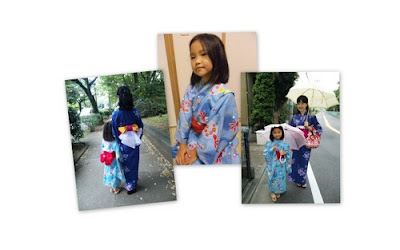
"Shichi (7) Go (5) San (3) literally means seven five three. When children read these ages, they are taken by parents or grandparents to a Shinto shrine in the neighborhood on November 15th to celebrate their growth." In our case, to avoid crowd in the shrine during those period, we chose to celebrate it earlier, November 1st, yes ... today!

"Originally, this was a custom done by many families of warriors and aristocrats but since the Edo period ordinary families started practicing it as well. Girls who have reached the ages of three and seven and boys who are three and five are dressed in traditional kimonos; long-sleeved (called furisode) for girls and haori and hakama with a model sword for boys."

Tuesday, October 27, 2009

The Bigger The Merrier


Apparently, it is not only the Americans and Europeans farmers who likes to compete on producing the largest pumpkin. In Toyama Prefecture, farmers conducts annual competition for pumpkin growers and this year, on its 23rd festival Hase-san succeeded to harvest 530.9 kilograms of pumpkin.

Friday, October 16, 2009

How Big Is Your Rice Bowl

This may become a culture shock for you who arrives in Japan for the first time. Say, you are at your friend's home, being invited to a homely prepared meal and you notice that there are rice bowls and cups of various sizes .... can you guess what that means?

In a traditional Japanese family, the size of rice bowl implies status or level of respect in the family, therefore a husband usually has the biggest size of rice bowl while the children have the smallest, and usually the elder gets a bigger one than the younger... and so on.

I bet this sort of culture can last only in a country like Japan... where people preserve culture and one of its culture is that "status or level of respect is considered important" even in a family and that one way to portray such a respect is through delicate items such as "rice bowl"... also "sake cup" and "tea cup" too!

(oops.... i better get a new set of bowls and cups ... to blend in more with the culture i live with :)

Friday, August 21, 2009

Yukata In Summer

Japanese summer calls for activities with a cooling effect, such as:
1. spending time in the water, such as public pool, resort pool, beach and river
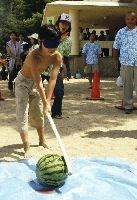
2. visiting summer festivals, where you can eat "kaki-gori" (or in Bahasa, es serut / in English, shaved ice) with colorful sauce of strawberry, green tea, blueberry and "lamune" (lemon soda), or a watermelon festival, where you get to break a watermelon with your eyes covered up.
3. taking a stroll in the park, hiking in the mountainside

Unlike in the old days when kimono was a daily wear for Japanese, nowadays the only time you can see many children and adults wearing kimono is during summer. Summer kimono is called yukata, which is worn only during July and August. Yukata has also become a popular souvenier for foreigners to bring home, because they are sold in various size, colorful and attractive, easy to wear and reasonable. (The price varied from 980 Yen to 20,000 Yen).

I used to wonder why the Japanese like to wear yukata in summer, considering the heat. However, I learnt that by wearing yukata you can take the heat off summer. Most Yukata is made of 100% cotton, that absorbs our sweat and it is designed in such a way that allows ventilation around the arms. Its long sleeves actually protects us from getting sunburn. Here is one of Japanese traditional customs that still lasts to these days . . . amazing!


Saturday, August 8, 2009

Bon Festival in August

Nowadays, i learnt that although many Japanese do not claim themselves to be Buddhist, they actually perform Buddhist customs with respect to honoring the spirits of ancestors. Mid August is the period where people here celebrates Bon Festival, a festival honoring the deceased, which was originally called the Feasts of Lanterns. In the past during this festival people would dance, called a Bon Odori.

Having said that, such customs are less formal nowadays among the younger people. Rather than going to the cemetery and honoring their ancestors, younger people usually just go to their hometown and meet with their family and relatives. They go to the local summer festival, where they can dance without specifically calling it a Bon Odori. The truth is Bon Festival has become a summer festival in Japan where people wear yukata (a summer kimono) watching summer fireworks, celebrating summer with watermelon party, watching carnivals ride and fireworks, playing summer games with family and friends.

Eventhough it is not declared as national holiday, most Japanese companies close for holidays during Bon Festival, for at least 3 days until about a week. Many activities in the government office also take a slow down during this period. In Tokyo, Yokohama and Tohoku region, Bon Festival is held earlier, which is know as Shichigatsu Bon or Bon in July, that is from July 15th. Others celebrates Kyu-Bon, which is from August 15th. Different region in Japan held the festival on different dates, but in general summer holiday here starts from mid July to mid August.

Personally, I think Bon Festival is an important period, where we can remind ourselves of our precious life through remembering the deceased, and celebrate it with those beloved people around us.

For more pictures of local celebration during Bon Festival, click below, from Akita Prefecture:

Friday, July 17, 2009

Agriculture & Earth Well Being

I was listening to a radio today and heard the news about Michelle Obama and 23 fifth-graders in the Washington D.C who just cultivated a 1,100 square foot land to develop an organic fruits and vegetables garden at the White House. Where obesity and diabetes have become a national problem, the activities are aimed at educating children, families and communities on the importance of healthy eating and reducing reliance on chemicals for fertilizers. What a wonderful idea and an excellent activity to do with kids.

I also heard that in Manhattan 20 green markets have become more and more popular, where more people nowadays find "green vegetables" a healthier and trendier choice than fast food. Green market that sells home-grown vegetables popped up everywhere in this big city and people started to show interests in growing vegetables in their own garden.

I think more and more people should realize how important is agriculture and its development to impact on earth well being, our health, our economy and our life as a whole. Economies of scale farming may be necessary as the population grow, chemicals may be inevitable to produce quality and quantity, however it may not the last resort. The future trend of farming could be something like .... smaller farming but at many location and run locally by the community.

In Tokyo having your own garden for farming is quite a luxury, due to lack of space. Those who live in apartment buildings usually do not have the capacity to do farming, where most of them can only grow mini tomatoes in small pot plants or some herbal plants. For a real farming experience they would need to rent a space somewhere out of the city, where they can cultivate a small piece of land. I know a few friends who have actually rented some spaces - together - in the outskirt and go there every weekend to cultivate and harvest.  Hm, I guess as long as the sun still shines ... agriculture is possible anywhere! Lack of space is not a problem but an opportunity.


Wednesday, July 15, 2009

O-chugen (=Gift Giving) Today

The custom of gift giving called "ochugen" in Japan actually originated from China, where it was conducted three times a year, January 15th, July 15th and October 15th. The same custom was brought to Japan, however here ochugen/gift giving is only practised on July 15th. Ochugen itself was related to the practise of remembering those who have passed away. However, the custom evolved to the practise of gift giving to thank those people who have been helpful to you.
Such customs of gift giving are conducted not only between friends, relatives but also between companies with good relationship. Recent data shows a trend of fewer practise of sending gifts between companies.

Ochugen is an important season for department stores and shopping centre to sell their best "packages" and compete for a larger share of profit in the gift giving business.

According to a national survey among 1904 Japanese women (conducted in May 2009), the practise of ochugen is common particularly among those age 50s and 60s, whereas among younger people of 20s - 30s, only one in two adopts such a custom. When asked about who they would send gifts to, sending gifts to parents, in laws, relatives are the three top answers whereas only 17.5% said they send gifts to "husband's boss/supervisor".

First three top answers for type of gifts: coupon/voucher, beer and sweets.

Tuesday, July 7, 2009

Tanabata Festival

On July Seventh we celebrate the Tanabata Festival. The festival itself originated from China and was inspired by the famous Chinese folklore, The Princess and The Cowherd. Children at kindergarten and schools will write a wish on a piece of paper which will then be hung onto a bamboo tree - a typical decoration for Tanabata.

Source: Wikipedia, Tanabata - The Story of The Princess and The Cowherd

Orihime (the Weaving Princess), daughter of the Tentei (Sky King or King of Universe), wove beautiful clothes by the bank of the Amanogawa (Milky Way, believed to be the "heavenly river"). Her father loved the cloth that she wove and so she worked very hard every day to weave it.
However, Orihime was sad that because of her hard work, she could never meet and fall in love with anyone. Concerned about his daughter, Tentei arranged for her to meet with Hikoboshi (Cow Herder Star), who lived and worked on the other side of the Amanogawa. When the two met, they fell instantly in love with each other. Enjoying each other's company, Orihime no longer was keen in working hard, while Hikoboshi let his cows to stray all over Heaven. In anger, Tentei separated the two lovers across the Amanogawa and forbade them to meet. At the loss of her lover, Orihime asked her father to let them meet again. Tentei was moved by his daughter's tears and allowed the two to meet on the Seventh of July, only if Orihime worked hard and finished her weaving. The first time they tried to meet, however, they found that they could not cross the river because there was no bridge. Orihime cried so much that a flock of magpies came and promised to make a bridge with their wings so that she could cross the river.
It is said that if it rains on Tanabata, the magpies can not come and the two lovers must wait until another year to meet.

2009 today on Tanabata's day, it is sunny and windy, a lovely summer .... children in Japan are so happy to know that Orihime and Hikoboshi can meet tonight (:

The city of Sendai celebrates Tanabata Festival in a very big way, and for many years this celebration has attracted local and international visitors. The celebration does not take place in July but August - this is mainly to accommodate local visitors, attracting family with children who are on holidays during summer.

Japanese site:

I also recommend JNTO (Japan National Tourism Organization), an English website, for more information about Japan:

Wednesday, June 24, 2009

The Rainy Season (梅雨)

In Japan summer starts with rainy season. Earlier rain takes place sometimes during May, or the latest in early July, but most often it rains a lot during the month of June. I suppose rain is the same everywhere, since it involves drops of water. However, during rainy season it can rain for days.

During this season children usually make a doll called teru teru bozu, which translate to "shiny- shiny Buddhist priest". The dolls can be made of white paper or cloth and they usually are hang by the window or outside as a symbol of children's wish for sunny days.

When i first arrived in Japan and travelled to countryside i saw some teru teru bozu and was rather shocked at first. I thought those dolls are some sort of "ghost symbols" and people were hanging them by the window. Later on i realize that it was part of Japanese culture to use symbols to express feelings, such as during children's day they would decorate the house with Hina dolls, Kabuto or Koi-nobori.

Friday, June 19, 2009

Tadpoles Phenomenon

Local and international news, as well as various blogs recently covered the story on tadpoles phenomena that took place in Ichikawa Prefecture, central Japan. The news here said that the local residents found about a hundred tadpoles lying dead in a dry area, measuring about 10 square metres. There was no water around the area that could suggest they might have breed nearby.

Sad... how could it be possible?

It is a very shocking news, but at the same time it reminded me of how important it is to keep our environment safe and sound, that there is still a place for those little insects, fishes and frogs to grow and for the kids to enjoy watching.

There is a park near our home that has about 100 meter square pond right on the side, where you could see a few types of habitats, such as minnows, ducks, and in spring time tadpoles. (photos taken - April 7, 2009)

Like most children in the park, my daughter also loves watching tadpoles swimming in the pond and parents just love their children standing by the pond, eagerly watching those little black creatures swimming around water.

In early summer, just after the rainy season we get the chance to enjoy the sound of frogs singing through the night... a lovely natural music to accompany a nice walk after dinner.

Lets keep those tadpoles alive in the right environment for our kids to learn that the nature is about survivability but it is us, humans, who are responsible to sustain it.


Thursday, June 11, 2009

Best Time To Be A Bride

This may be quite an embarrasing note, but frankly it was only recently that i found out how the word June Bride came around. The name June came from the Roman myth, June was the name of a Goddess who unite a couple into a marriage. The story telling said that getting married in June will bring happiness to the couple. In the past getting married in June was common in Europe, because in the region where Catholics were the majority, spring was a season for celebration and spring called for a big Easter celebration that took place during March to May. In June people are less busy with their religious commitment, so couples chose this blessed month to get married.

Another reason why some people choose to get married in June is because of weather. In Europe, especially England and France, June has the longest daylight and the least amount of rain.

How about Japan? Spring and autumn are the most popular season to get married. However nowadays there are some women who choose to marry in June, simply because the Japanese society has in many ways adopted the European way of getting married in a white wedding gown, having the ceremony in a chapel, listening to prayers by a priest/pastor - eventhough none of the couple know anything about God or Christ. Eventhough June is in fact rainy season here, some people here still like to import the European style of bonding.

Other Japanese pick the best date to get married by looking at the calendar for "大安" (read: tai-an), which is believed to be the best day for marriage or celebration. Like the Chinese and Koreans, the Japanese also believe that each date carries different luck and 30 days of each month are calculated based on stars, each will fall into one of the 6 various type of lucks. Tai-an is believed to be the luckiest day of the month.

Well.... FYI, i did not get married in spring nor autumn. I think the best time to be a bride is when you find the best groom. It is not really when you got married, "to whom you got married" matters more. I am sure many of you agree on this one.

Wednesday, June 10, 2009

Emotionally Intriguing


(Please click the above and turn on the music, a piano recital by Nobuyuki Tsujii, a blind pianist while you read the following story)

Just the other day i read the news about a Japanese blind pianist who won Van Cliburn International Piano Competition 2009 in Texas. He was not the only blind pianists joining the competition, but he successfully went through all the hard selection process and in the end won the first prize in one of the world most difficult piano competition.

It is hard to imagine how a blind person can read musical notes, but apparently in the case of Nobuyuki Tsujii, he did not have to read notes at all, for he can remember, even when reciting Chopin, Rachmaninoff or Beethoven Piano Sonata 23 during his final presentation at the Van Cliburn International.

We have heard of other stories perhaps, about disabled persons who strive and succeed, and how they bring an emotionally intriguing episode, such as that of Helen Keller. I found Nobuyuki Tsujii emotionally intriguing as well. In many ways those who live with no disability are reminded throughout our lives that we have it all and that there are people out there who do not have it, yet they can amaze us all.

I was so very touched and very happy to see that a blind person can bring such an amazing beauty to music and hopefully more than that, he can open the eyes and heart of people who listen that God has blessings for each one of His people - who believe that even when at times you can not see the path...... there is always a way!

Note: Nobuyuki Tsujii's success was not due to his own strength as he had the full support from his beloved parents and a dedicated teacher. In an interview he spoke about his memory as a child, when his parents took him to museums to see beautiful paintings, even though he could not see. They would talk about the paintings and go through each one with him patiently. He said that he was very grateful for he learnt so much from listening to them ... i suppose for having the hope and being trusted for many more beautiful things to come.


Friday, May 15, 2009

The Way of Nature

Today i was surprised by a flock of birds chirping noisily as i had my morning tea alone.   I looked out into the garden and saw about 10 little birds flying back and forth from one tree in my garden to various spots around it.   They seemed to be eating something, so i watched closely.  

The birds came back and forth the "yuzu" tree, not a very tall tree, as i cut the top regularly so it only grows up to my shoulder.  It has been a good tree, bearing about 6 to 10 yuzu fruit every winter. 
   
I remember more than two weeks ago i noticed a few butterflies flying around it and earlier this week i was worried when i saw some young leaves eaten.  I contemplated about picking those caterpillars, not quite sure if i have the gut (nor the heart) to kill them as much as i am scared even to touch them.    I could have asked my daughter who is never scared of any insects, but i know she would say no to killing her favorite insects.

Now i was somewhat relieved to see the birds feeding on the caterpillars and some of the larvae. After all the nature works so wonderfully around us that we sometimes should take our hands off and just watch the wonder of God's creation.   

As i am typing this, i can hear the chirping noise quiet down.   They had finished lunch, i guess.   Now it is time for mine....


Monday, May 11, 2009

Children's Day May 5th - For Boys? or Both?

In Japan Children's Day celebrated on May 5th is a celebration not only for children but also for a meaningful day for mothers.   Since 1948 the Japanese Government dedicated May 5th as a national holiday - a day to celebrate children - to appreciate the well being of children and a greetings for the children with appreciation to their mothers.   However, the Japanese people in general follow international calendar (May 10th) when celebrating Mother's Day.

The celeberation of Children's Day has been around in Japan since early 1900, during the Taisei Period (1912).  In the past Children's Day was mainly a celebration for the boys - originally it was a celebration to wish health for boys. Meanwhile, girls has their during the Hinamatsuri Festival.   However since the Hinamatsuri Day on March 3rd was not announced as a national holiday, while May 5th was dedicated as a national holiday, at some point in time people started to argue that there was a discrimination between boys and girls.    In the last few decades, the culture of celebrating only boys on May 5th has gradually changed.   Practically boys and girls enjoy May 5th the same way at home and anywhere else, such as they can both get into the national zoo, national museum and other public facilities for free on that day.

The most common way of celebrating children's day are to place a decoration called "Koi-nobori".   In the past families with boys put up "Koi-nobori" or carp streamers, in their garden and a display of dolls called gogatsu ningyo (the same way families of girls display Hina dolls during Hinamatsuri Festival) in a room of the house.   Nowadays, families with children put up "koi-nobori" regardless of their children's gender.  The meaning of "koi-nobori" display " the carp appear to be swimming vigorously against the current" is to symbolize how boys should face and overcome their difficulties with the same positive spirit.   

Gogatsu ningyo or dolls for boys celebration usually contains a set of samurai armour, a kabuto (samurai's helmet), a taiko (big drum) and other things needed to fight an old style battle.  This decoration also symbolizes that boys should be strong to face any difficulties with the necessary equipments.   Families with girls do not display gogatsu ningyo, instead they put up "koi-nobori" which has similar meanings.

For the first time ever, on May 4th 2009 (US Time) US Secretary of State made a statement on Japanese Children's Day, May 5th.

It is my pleasure to offer warm wishes to boys and girls in Japan on the May 5 occasion of Children’s Day. On this holiday, Japanese families celebrate the joys of childhood and family life. Children are, indeed, a national treasure, and both the United States and Japan share a strong commitment to childhood health, safety, and education. It is a responsibility for all of us to work together to ensure the protection of children. It is our hope that one day children from all countries will be able to celebrate the carefree joys that children in Japan celebrate today.